Thursday, April 17, 2008

--work-properly

[reading: Jean Hugard & Frederick Braue, "The Royal Road to Card Magic (revised edition)"; recently Henning Nelms, "Magic and Showmanship: A Handbook for Conjurers"]

Today's --work-properly option: adding -rdynamic (a.k.a. --export-dynamic) to a GCC link line will mean that any dlopened libraries are able to bind to the symbols in the running executable.

Monday, February 25, 2008

Remote Reset

[reading: Neil Gaiman, "Eternals"]

Someone at work was complaining the other week about the difficulties of testing with the OSE board. The board needs to have the reset button pressed after each test, and the problem was that the board lives in the machine room at the other end of the building.

I remembered that I had an old Lego Mindstorms set rotting in the cellar, so I decided to help out:

P1010535

One of the motors had died in the meanwhile, but a contraption to press a button only needs a single motor. The software had rotted quite badly too—the old software that came with the set wouldn't work with XP, and there didn't seem to be any updates on the Lego website.

Open source to the rescue: the NQC compiler together with the Bricx IDE sorted out the 6 line program that I needed, and so remote reset was born.

hardware

Saturday, December 22, 2007

O for Oxygen, 0 for Zero

[reading: Bjørn Lomborg, "Cool It: The Skeptical Environmentalist's Guide to Global Warming"; recently Charles Stross, "The Jennifer Morgue"]

Shocking. The reporting of science in the media has always been pretty rubbish, but the BBC News website can't even spell CO2 correctly.

I'd let them off not doing the subscript correctly, even though it's not exactly difficult to do <sub>2</sub> or &#x2082; for '₂' (U+2082).

But not being able to spell "O" correctly is just impressively awful. And it's endemic.

Tuesday, September 25, 2007

Denied

[reading: Michael Spivak, "Calculus"]

Bugger. It turns out that the Apple rep who told me on the phone that the new iPod Classic would work with Mac OS X 10.3.9 was lying.

ipodissue

I don't really want to have to buy Mac OS X 10.4. I particularly don't want to have to buy 10.4 a mere month before 10.5 comes out. It's especially annoying as I spent a while cleaning up my music library and getting album art for everything in anticipation of the Arrival of the New Toy.

So I guess I've got an expensive paperweight for the next month or two (until 10.5 comes out).

Monday, June 11, 2007

Bogo-Permute

So here's today's random question, apropos of, er, nothing. What's the performance of the following incredibly-poor algorithm for randomly permuting a list of numbers?

def bogo_permute(in_list):
    N = len(in_list)
    out_list = []
    # Keep track of whether we have dealt with each element of the input list
    seen = [False] * N
    for iteration in range(N):
        while True:
            which = randrange(N)
            if not seen[which]:
                out_list.append(in_list[which])
                seen[which] = True
                break
    return out_list

There are N selections needed for the output list. The first time through, the randomly selected entry from the input list will definitely not have been processed already, so it can be transferred across to the output list. The second time through, there's a chance that the random selection process will select the same entry again; for later iterations, this chance of selecting something that has already been selected will get higher and higher. So, on average, how many of these repeated picks are needed?

Given a coin that comes up heads with probability p (and so tails with probability q=1-p), what's the average number of coin tosses needed before the first heads comes up?

As an example, imagine that the first head turns up on the fourth toss. This means that the sequence of tosses is TTTH. The probability of this sequence of coin tosses is then q3p = (1-p)3p. This is easy to generalize:

Number of TossesSequenceProbability
1Hp
2THqp
3TTHq2p
4TTTHq3p
mT…THqm-1p

We want the average number of tosses needed to get a head, also known as the expected value. This is a sum of the each possible value multiplied by the probability of that value occurring. In other words, the average number of tosses needed is:

(1*(probability of heads on first toss) + 2*(probability of first heads on second toss) + 3*(probability of heads on third toss) + …)

Put into maths, this means that the average number is an infinite sum: Σm=1 m (qm-1p). From a trusty binomial expansion, the Σm=1 m qm-1 part pops out as (1-q)-2, and since q=1-p this means that the whole thing simplifies down to just 1/p.

(This seems reasonable: for a fair coin, it takes an average of 2 throws to get a head; for a coin that only comes up heads one time in a hundred, it takes an average of a hundred throws.)

So back to the original problem. For the i-th selection (with i running from 1 to N), the chance of picking an array entry that is still there is p=(N+1-i)/N, and so the average number of picks needed is N/(N+1-i). The first selection needs N/N = 1 attempt, the second selection needs N/(N-1) attempts, the third selection needs N/(N-2) attempts, …, the last selection needs N/1 = N attempts (on average).

Taken together, this means that the average number of random picks for the whole process is Σi=1N N/(N+1-i). Rearranging (with j=N+1-i) this is the same as N Σj=1N1/j, which includes a partial sum of the harmonic series, known as a harmonic number HN. In the large N limit, the harmonic numbers tend to HN ≈ ln(N) + γ (where γ is a constant), and so the asymptotic behaviour of the algorithm is O(N ln(N)).

So it's bad, but not quite as bad as I'd expected (I'd guessed it would be O(N2)).

Friday, May 04, 2007

inline_related_objects

[Edit, Feb 2008: fixed typo—changed extra_content to extra_context]

Today's neat Django trick: getting the create_update generic views for a model to display entries from a subsidiary model in-line—like the admin interface does when you add edit_inline=models.TABULAR.

The (oldforms) Form object that gets generated by the create_update view already has most of the required gubbins inside it; we just need a few extra steps to get at it:

  1. In urls.py, set an extra_context argument for the view to be a dictionary that contains inline_related_objects:
     {'inline_related_objects': model._meta.get_followed_related_objects(None) } 
  2. In the template, include a loop to pull in all of the related objects:
     {% for related_object in inline_related_objects %}{% edit_inline related_object %}{% endfor %} 
    within the <form> tag.
  3. Since the edit_inline template tag is not a built-in Django tag, the template also needs to load up the admin_modify extension:
     {% load admin_modify %} 
  4. Make local copies of the relevant admin templates (such as admin/edit_inline_tabular.html and widget/foreign.html) and tweak appropriately.

Of course, I didn't figure this out until after I'd spent a couple of hours dismantling the admin interface code with a view to stealing the relevant bits. Roll on the Django book.

Saturday, April 14, 2007

The Joy of UNIX

UNIX credo: you can do anything from a single command line (as long as the line is allowed to be arbitrarily long).

Case in point: generating a white noise audio file

sox -t sl -r 44100 -c 2 /dev/zero \
-r 44100 -c 2 -w whitenoise.wav synth 10:00 whitenoise vol 0.6 fade q 10 10:00 10

Friday, March 16, 2007

Magic Number

And the number is: 978-1-84753-300-5.

Sunday, February 25, 2007

The Spine is Evil

[reading: Skippy Blair, "Disco to Tango and Back"; recently: Simon Lovell, "How To Cheat At Everything"]

Drat; forgot to add extra space on the inside margins of my current typesetting project, so I had to go back through all of the chapters and re-set everything. Like the man said, the spine is evil.

Wednesday, December 13, 2006

Django Su

It's always a sign of good design when adding a new feature turns out to be easy.

In the Django authentication system, I wanted a way for an administrator to view the site as if they were a particular user; effectively an equivalent to su in UNIX-land.

The first easy step was to invent a URL to correspond to this action, which gets encoded in urls.py:

  (r'^su/(?P<username>.*)/$', 'qlockweb.accounts.views.su', {'redirect_url': '/qlockdata/'}),   

That done, the second and final step is to write some view code.

  @user_passes_test(lambda u: u.is_staff)
  def su(request, username, redirect_url='/'):
      su_user = get_object_or_404(User, username=username)
      if su_user.is_active:
          request.session[SESSION_KEY] = su_user.id
      return HttpResponseRedirect(redirect_url)

Seven lines of code and we're done (modulo a bunch of import statements).

Expanding what's going on here:

    (r'^su/(?P<username>.*)/$', 'qlockweb.accounts.views.su', {'redirect_url': '/qlockdata/'}), 
  • When an HTTP request arrives at the framework, Django goes through its list of URLs until it finds a match. In this case, going to http://mysite/accounts/su/fred/ ends hitting the urls.py line above; the /(?P<username>.*)/ part of the regexp pulls out "fred" and this gets passed as a parameter named username into the function su in qlockweb/accounts/views.py. This function also gets passed a parameter called redirect_url with value '/qlockdata/'.
  • @user_passes_test(lambda u: u.is_staff)
  • Actually, we need to rewind one step before we get into the su function. The line before the function definition is a Python decorator: some extra code wrapping the function that gets executed just before the function itself is executed. This decorator needs some expansion of its own:
      @user_passes_test(lambda u: u.is_staff)
    • The @ sign is the syntactic sugar that indicates that this line is a decorator for the function that comes immediately afterwards.
    • @user_passes_test(lambda u: u.is_staff)
    • This is the decorator function (from contrib/auth/decorators.py); its first argument test_func is a function that does the test. This test function is given a single parameter: the current User. If the test function returns true, the wrapped view code is called; if not, then the user gets redirected to a login page.
    • @user_passes_test(lambda u: u.is_staff)
    • More syntactic sugar. We want a function is_this_a_staff_user(u) that checks whether its argument u is an administrator. However, as this is the only place that the function is used, we don't bother to give it a name—we just use a lambda expression to give the definition right here and now.
    • @user_passes_test(lambda u: u.is_staff)
    • Finally, the body of the lambda expression just uses the method of the User class that indicates whether the user is an administrator or not.
  • def su(request, username, redirect_url='/'):
  • So now we're in the su function itself, and if we've got this far we're guaranteed that the person viewing the page is logged in as an is_staff user. The function has the username and redirect_url parameters mentioned earlier; it also has a request parameter that holds all of the information about the original web request (in a HttpRequest object).
  •   su_user = get_object_or_404(User, username=username)
  • The next line of code gets a User object for the username that was specified—fred in other words. If there isn't a user called fred, then a Http404 exception gets raised, which will percolate up the stack and display a (surprise, surprise) 404 page.
  •   if su_user.is_active:
  • This particular version of our code only allows impersonation of active users, helpfully provided by the is_active field in the standard User model.
  •     request.session[SESSION_KEY] = su_user.id
  • The next line of code is the one that actually does the work. The requesting user's session is modified so that its user ID is the impersonated user's.
  •   return HttpResponseRedirect(redirect_url)
  • The final line of code redirects the web browser off to the redirect_url page.

(Statutory disclaimer: I am not a security expert, nor do I play one on TV. Adding this to a production system is probably not a good idea.)


Another Django snippet: I finally discovered that the follow argument to the standard Manipulators allows you to list fields in the model that the form should leave untouched. Very helpful: the end result is more compact and less brittle than the code I'd put together to manually override all of the hidden fields.

[A:37385 B:3278 C:346 D:9187 E:62544 Total:112740]

Saturday, December 02, 2006

Mind Hack #39

[reading: Jón Árnason, Alan Boucher (translator), "Icelandic Folk Tales"]

One of the MindHacks that doesn't include an easy demonstration is Hack 39, where you're less likely to notice a trigger event if it occurs soon (say, <0.5s) after another trigger event.

(Now that I've got into the content rather than being distracted by the typesetting, the book is turning out to be rather good.)

My first attempt to test this out is below, but I have to say that the effect didn't seem all that strong to me—so maybe there's a bug or I've implemented it wrong. Or maybe I'm just too impatient to run it for long enough to get statistically significant data.

After hitting "Go", this applet will display letters for a tenth of a second each. You should hit a key whenever the letter displayed is either "X" or is displayed in white. To stop the applet, hit "Stop" or press the Escape key.

After running the applet, the bar graph shows the time between triggers (on the X axis) against how many triggers there were with that delay; the white is the total number shown, the black is the subset of them that were missed. Hitting "Go" again accumulates more data.

(Download source code)

Technical Details: letters are picked uniformly (so there's a 1/26 chance of a letter X trigger) and white is used for the colour 1/20 of the time. A trigger is considered hit if there's a keypress within 1 second after the trigger, but each keypress only counts once (so "trigger, trigger, keypress, letters…" would count as one hit then one missed trigger, with a delay of 1).

[A:37385 B:3278 C:346 D:9187 E:46445 Total:96641]

Thursday, November 30, 2006

*knolp*

[reading: William Faulkner, "As I Lay Dying"; recently Neil Strauss & Bernard Chang, "How To Make Money Like a Porn Star"]

Now that I've got Django installed and running, I've been setting up my first web application with it.

I spent a bunch of time yesterday trying to figure out how to get extra parameters passed through a generic view; in the end I had to UTSL to get a method that worked.

So of course today I find a nice page that concisely and coherently explains it, rather more quickly than the couple of hours it took me to figure out.

Perhaps I can suggest *knolp* (the reverse of *plonk*) as the sound of an RSS feed hitting my aggregator. (It looks like I'm not the first person to think of this.)

[A:37385 B:3278 C:346 D:9187 E:46320 Total:96516]

Saturday, November 25, 2006

&numl;

[reading: Derek Young, "Rock'n'Roll Dancing"]

Here's a question: is there a Unicode character for an N with an umlaut?

(Triggered by eating a splendid dessert of brownies and Häagen-Dazs ice cream, which made me think of that most famous of fake umlauts, the one in the name of "Spinal Tap").

Oh, and compounds like U+006E U+0208 (i.e. 0x6e 0xcc 0x88 in UTF-8) don't count.

[A:37385 B:3278 C:346 D:9187 E:39180 Total:89376]

Tuesday, November 21, 2006

Editing Hacks

[reading: Tom Stafford & Matt Webb, "Mind Hacks"]

Started reading "Mind Hacks", which looked interesting in the bookshop but the formatting is already starting to annoy me. In that respect, it's the worst book-that's-just-a-printout-of-a-cool-website ever, and that's up against some pretty stiff competition.

  • A large fraction of the hacks refer the reader off to movie files or Flash animations on the web. Not very helpful for a physical book that you might want to read on a train.
  • "Color: The second color is used to indicate a cross-reference within the text". Except that there is no second color—the relevant parts just come out in a hard-to-read light gray.
  • The halftoning for photographs and some of the diagrams is poor—it looks like the output of an 1980's laserprinter.
  • I don't know what system they used to produce the book, but it's generated some real oddities in linebreaking (mostly around URLs). Favourite so far: a line break after the decimal point in "3.3" (page 144).

Still, the content might be OK once I get into it, and at least they include lots of references to the original literature.

[25-Nov-06] Edited to clarify that I'm complaining about the formatting rather than the content. Feeling slightly guilty given that one of the authors came over and commented. You'd think I'd have learnt my lesson about who finds what on tha intarweb.

[A:37385 B:3278 C:346 D:9187 E:34361 Total:84557]

Thursday, November 09, 2006

One Year In

[reading: Seamus Heaney, "North"]

Just noticed: it's a year since the original idea for the company.

Thursday, August 17, 2006

The Truth Mines

In the Truth Mines, though, the tags weren't just references; they included complete statements of the particular definitions, axioms, or theorems the objects represented.

Every tunnel in the Mines was built from the steps of a watertight proof; every theorem, however deeply buried, could be traced back to every one of its assumptions. And to pin down exactly what was meant by 'proof', every field of mathematics used its own collection of formal systems: sets of axioms, definitions, and rules of deduction, along with the specialised vocabulary needed to state theorems and conjectures precisely.*

I came across a cool maths site today (via Good Math, Bad Math). I'd actually been thinking about doing it myself for the last few years, but it always looked a bit too much like hard work (even when I had Copious Free Time), so I never quite got around to it.

It's kind of eerie, though—the proof pages are almost exactly like the ones I'd mocked up and had in my head when I was playing with the project (although less XML/MathML-y). I guess there aren't really that many different ways you could present it, but it does feel like some sort of noodly appendage has sucked the idea right out of my head and served it up as a completed web page (conveniently skipping the tedious business of doing all the work).


* Greg Egan, "Diaspora", 1997

Friday, June 09, 2006

How do I exit thee? Let me count the ways

[reading: Tom Holt, "Alexander at the World's End"]

Today I've been trying to sort out the interactions between the various different mechanisms for generating and catching errors in Windows. With the help of a noddy test program, I ended up with:

Type No handler atexit signal catch (...) set_terminate __except (EXCEPTION_EXECUTE_HANDLER) __except (EXCEPTION_CONTINUE_EXECUTION) SetUnhandledExceptionFilter
exit(0) No message Hit
abort() Visual C++ Runtime Error dialog Hit (SIGABRT)
c=*(char*)0 'Encountered a problem and needs to close' dialog Hit (SIGSEGV) Hit Hit Hit, generates infinite loop Hit
i=1/0 'Encountered a problem and needs to close' dialog Hit Hit Hit, generates infinite loop Hit
raise() No message Hit, execution continues from the raise
throw Visual C++ Runtime Error dialog Hit Hit Hit
RaiseException(0xE0000001,EXCEPTION_NONCONTINUABLE, 0, NULL) 'Encountered a problem and needs to close' dialog Hit Hit Hit Hit
RaiseException(0xE0000001, 0, 0, NULL) 'Encountered a problem and needs to close' dialog Hit Hit Hit, execution continues from the RaiseException Hit

Other key points to note:

  • All catchers only see errors from the same thread, with the exception of the SEH unhandled exception filter set by SetUnhandledExceptionFilter().
  • For (say) a null dereference, the order that various handlers get to see things is:
    • Vectored Exception Handler (VEH)
    • C++ exception handler or Structured Exception Handler (SEH), whichever has the narrower enclosing scope
    • SIGSEGV signal handler /* FALLTHRU */
    • SEH unhandled exception filter installed by SetUnhandledExceptionFilter
    • C++ unhandled exception handler installed by set_terminate
  • I've no idea why a null dereference does appear as a C++ exception in a catch (...) block, but doesn't hit the unhandled-C++-exception-handler installed by set_terminate.

Saturday, June 03, 2006

Plenty Of Blood

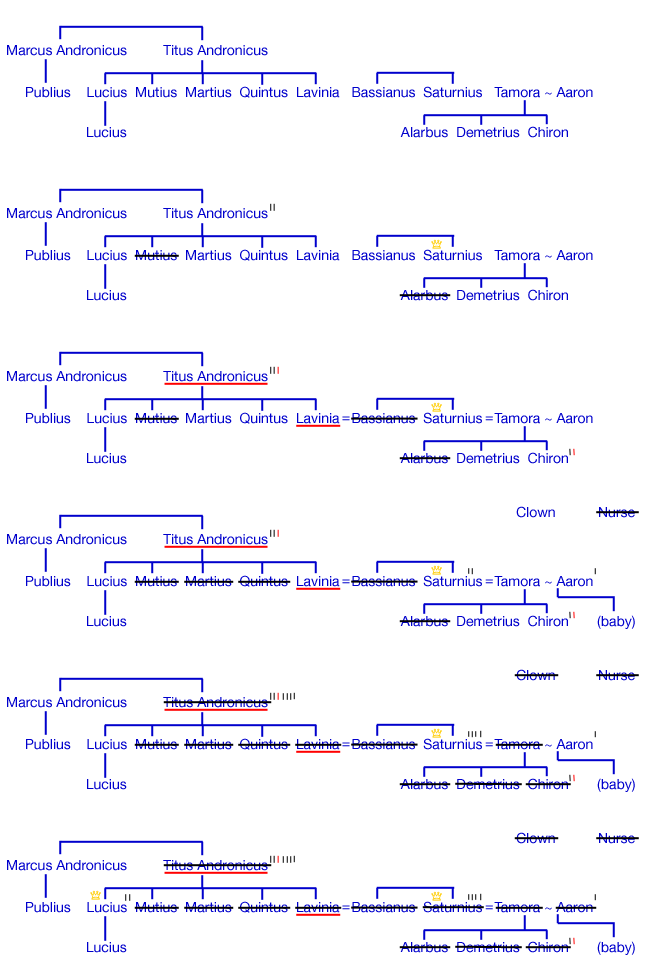
Finally getting around to booking Titus Andronicus at the Globe, so here's your cut-out-and-keep* guide to Shakespeare's bloodiest play:
Titus Andronicus


*OK, not really.

Monday, April 10, 2006

Day 342

[reading: Dave Sim, "Cerebus"]

[Edit 7-Nov-2007: I've since found a couple of good explanations.]

In my photography course yesterday, I found myself explaining how flash sync speeds work. To my surprise, there doesn't seem to be an easily-googleable explanation online, so I though it might be worth writing up:


The flash sync speed for a camera is the fastest shutter speed you can set and still use flash. It varies from camera to camera: more recent and more expensive cameras are faster, older cameras are slower (and often have the sync speed helpfully marked in red on the speed dial). If you try to use a shutter speed that's faster than the sync speed you end up with pictures like this:

sync

So what goes wrong?

The first thing to understand is how the camera's shutter works. If you could slow down time, you'd see a sequence like this:

60

There are two shutter curtains that pass down the frame from top to bottom. This first opens things up to light, and the second closes it again. As the shutter speed gets faster, we reach a point where the shutter never completely opens during the sequence:

250

Each area of the frame is exposed for the same amount of time (because both shutter curtains move at the same speed), but the top and bottom parts of the frame aren't exposed at the same time.

The second thing to realize is that flash is very fast—much faster than the fastest shutter speed on the camera, maybe 1/16,000 to 1/50,000 of a second. Revisiting our two sequence diagrams:

60flash

At this speed, everything is fine. The flash triggers and illuminates the whole of the image. At the faster speed, problems arise:

250flash

If we think of the flash as being effectively instantaneous, then because there is no moment where the whole of the frame is exposed at once, there's no moment when the flash could fire and illuminate the whole of the scene. This also explains the sort of problems that occur in the final image:

  • Dark bar at the top of the frame (illustrated above): the camera has triggered the flash when the first shutter curtain reaches the bottom of the frame, but the second curtain is already obscuring the top of the image.
  • Dark bar at the bottom of the frame: the camera has triggered the flash when the second shutter curtain is about to start at the top of the frame, but the first curtain has not yet exposed the whole of the bottom of the image.
Model: Bernard T. Bonsai.


And in other news, we've now had our first directors meeting for the new company.

Monday, March 27, 2006

Day 328

A trifle bizarre. After a bunch of investigation, I eventually narrowed down a synchronization problem to the following mini test program:

#include <time.h>
#include <stdio.h>
int main()
{
  time_t tv = time(NULL);
  struct tm *tms = localtime(&tv);
  printf("%02d:%02d:%02d DST:%d\n", 
         tms->tm_hour, tms->tm_min, 
         tms->tm_sec, tms->tm_isdst);
}
When I ran on Mac OS X:
~:date
Mon Mar 27 14:12:29 BST 2006
~:a.out
14:12:30 DST:1
But when I ran on my main Windows XP box:
c:\>time /t
14:13
c:\>localtime.exe
13:13:03 DST:0
Now, I'm usually happy to believe the worst of Microsoft, but it stretches even my credibility to think that their C runtime doesn't get the 1989 ANSI standard right (particularly as a quick web search didn't turn up any complaints).

Investigating further, when I ran the same code on a different Windows XP machine, I get the right answer:

c:\>time /t
14:15
c:\>localtime.exe
14:15:24 DST:0

So I checked MSDN and found some mutterings about "localtime corrects for the local time zone if the user first sets the global environment variable TZ...TZ is a Microsoft extension and not part of the ANSI standard definition of localtime. Note: The target environment should try to determine whether daylight saving time is in effect."

Running echo %TZ% from the command line showed up as GMT. So I tried changing the timezone to EST, but echo %TZ% was still reading GMT. Odd.

Eventually, I discovered that my login had TZ=GMT hard-coded into the environment (Control Panel, System, Advanced, Environment Variables). Not sure how it got that way, but finding it and making it not so has just taken a couple of hours.

[A:35029 B:3218 C:346 D:9187 Total:47780]